|
|
| Your complete Guide to the North Rim of Grand Canyon National Park. This guide also includes information on Lodging, Camping, Guided Tours, Maps and Vacation Retreats in the Southwest area including Utah and Arizona. This site is packed with information and photos of the North Rim of the Grand Canyon and the surronding areas of interest. |
|
|
|
Zion, Bryce and Grand Canyon are all located in the Great Basin Desert. Here in the desert when it rains, it does so in volumes, the soil cannot absorb the moisture so quickly leaving the terrain dry. The few snows in the winter help maintain a better balance, but still the hot dry days lead to evaporation. The Great Basin Desert is called a cool desert due to at least half of its moisture coming from the winter snow. Many of the animals have learned to adapt to the high temperatures and the scarcity of water by being active at night or burrowing into the ground during the hottest parts of the day. Appreciate the diversity of these creatures, they are quite adept to living through the winter as well as the hot summers. Hiking many of the hikes in Zion, Bryce and Grand Canyon involve a change in elevation. This allows for many different microenvironments or natural life zones.
|
|
Although the parks are in the desert the animals are diverse like the plant life. Seventy-five species of Mammals are found in Zion alone. The mule deer (Odocoileus hemionus) is a common site in the park compared to the secretive and nocturnal mountain lion. There has never been an attack by a lion in the park. The coyote (Canis latrans) and the Gray Fox (Urocyon cineroargenteus) can be seen once in a while.Squirrels are perhaps the most seen mammals in Zion. Rock Squirrels (Spermophilus variegatus) and the White-tailed antelope ground squirrel (Ammospermophilus leucurus) are common. The tiny little Least chipmunk (Eutamias minimus) can be seen rushing about in rocky areas as well as wooded areas. Other common mammals include the beaver (Castor canadensis), the porcupine (Erethizion dorsatum), striped skunk (Mephitis mephitis). The black-tailed jackrabbit (Lepus californicus), a hare can jump at 35 mph. Those long ears of the jackrabbit help keep the animal cooler by providing a large surface area of radiating body heat. The warmed blood is circulated and cooled in the thin tissue of the ears. The smaller desert cottontail (Sylvilagus audubonii) is slower moving with a busy white
|

| Waterfall off the highway |
|
|

|
The bighorn sheep is becoming a rarely seen animal, but is often sighted in Zion along the switchbacks. Once an abundant anima in the southsest, but the species has been hunted to this end result. Many of the Parks are trying to reintroduce the bighorn into the area.
|
|
There are two-hundred-seventy-one species of birds. The rare California Condor is among them. This magnificent bird was known to the ancient ones as the Thunderbird. At the end of 2002, the protected and endangered Condor was found, killed by a human. There are currently less than 200 in existence, but they are known to be in Zion, Bryce and Grand Canyon. The Red-tailed Hawk (Buteo jamaicensis) is the most common of the Hawks in Zion. The American Kestrel (Falco sparverius) is a small and very pretty falcon. A few other interesting birds include the western kingbird (Tryannus verticalis), Hairy Woodpecker (Picoides pubescens), and the great horned owl (Bubo virginianus).
|

|
The Endangered California Condor is found in Zion, Bryce and Grand Canyon
|
|
|

|
This a common King Snake that I could not resist holding for a moment. It was found just outside the park. Remember never to feed or handle the animals in the park
|
|
Thirty-two reptiles, with only the great basin (Crotalus virdis lutosus) rattle snake being dangerous. Reptiles are ectotherms, animals who's body temperature changes with the environmental temperature. Lizards are all along the trails and it is of interest how they change when hiking a trail which changes greatly in elevation. Commonly seen is the eastern fence lizard (Sceloporus undulatus elongatus), identified by the blue blotches on his underbelly. The western whip-tail lizard (Cnemidophorus tigris) and the Plateau are identified by their long tails. The horned lizard (Phrynosoma spp.) not as common in Zion, but quite interesting. This creature inflates when in danger and hisses. The horned lizards flatten their bodies and turn perpendicular to the suns warmth and then parallel to cool down. flat and wide body, often called a horny toad.
|
|
Some common amphibians include: The Canyon Tree Frog, a small dusky colored frog which has a beautiful bird like call that is heard in early spring. The great basin spadefoot toad (Spea intermontana). A nocturnal toad with greenish gray coloring. The red spotted toad (Bufo Punctatus) identified by its reddish bumps on the ski and its small size. The northern Leopard frog (rana pipiens), a nocturnal frog identified by its back and forth flee when startled. There are also 8 species of fish in the area.
|

|
|

|
A tree adapted to desert life
|
|
Almost eight-hundred native species of plant life are found in Zion. Plants must also adapt to the hot summers and cold winters of the Parks. The Cactus is a good example of this efficiency, hoarding water and keeping it from evaporating by a thick wax coat. Many of the plant life in the parks have adapted by forming deep, long roots, while others are perennials.
|
|
The Fremont cottonwood (Populus fremontii) lines the Virgin river of Zion. Tall trees, with roundish leaves. The evergreens, Juniper and Pine, are widespread. The Juniper has a bluish berry like fruit which takes 2 years to mature. The bark is fibrous, peeling off easily. The early settlers made us of the easily frayed material for things like diapers and bedding. The Single-leaf Pinyon is the common pine seen on the rocky mountain sides in Zion. Just like the wildlife the plant life changes with elevation. At about 5,000 feet the Pinions and Junipers are found, above that is the Pine and Oak, then the Fir and Aspen and at the top the Spruce and Fir are found.
|
|

|
There are poison ivy in the park, along with the more common sacred datura (Datura wrightii). Never touch either of these plants, some people have severe allergic reactions to them. It would make you trip very unpleasant. |
|
Along the wetter sections of hikes the maidenhair fern (Adiantum pedatum & capullus) can be found. These are dainty fronds on a strong length of black stem.
Another delicate plants is the white tufted evening primrose (Oenothera casespitosa). The flowers are large and white, opening at night. Another primrose is the pale evening primrose (Oenothera pallida), smaller that the evening primrose.
Palmer Penstemon (Penstemon palmeri) is common, flowers are like small white cups. The Utah penstemon (Penstemon utahensis) has a lobed flower tube, the flowers are red. The Indian Paintbrush (Castilleja) grows in dry areas, often seen along the road. The red bracts look like colored leaves.
|
|
|
|
Cactus often seen include the Prickly Pear, the Claret Cup Cactus and the Purple Torch named after its purple flowers. The fruits can be made in to jelly and used in many dishes in Mexico. The Yucca has the tall blades adapted to channeling water to its roots.
Lichens are found throughout the parks, an indication of clean air, being sensitive to oxides of nitrogen and sulfur. Finding lichens in a city would be unlikely. Lichens are a combination of algal cells and fungal filaments living together in what is called a symbiotic relationship. |
|
|
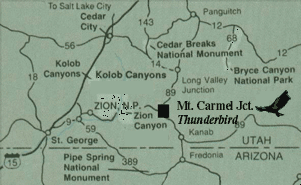
Scenic Byway 9 through Zion Park to Mt. Carmel Jct. is open year round.
|
|

for more Info:
|
| |
This free scr
ipt provided
JavaScript Kit
Local Weather and Golf
Ingenious Solutions© Copyright 2003
|
|
|
|





